
TL;DR
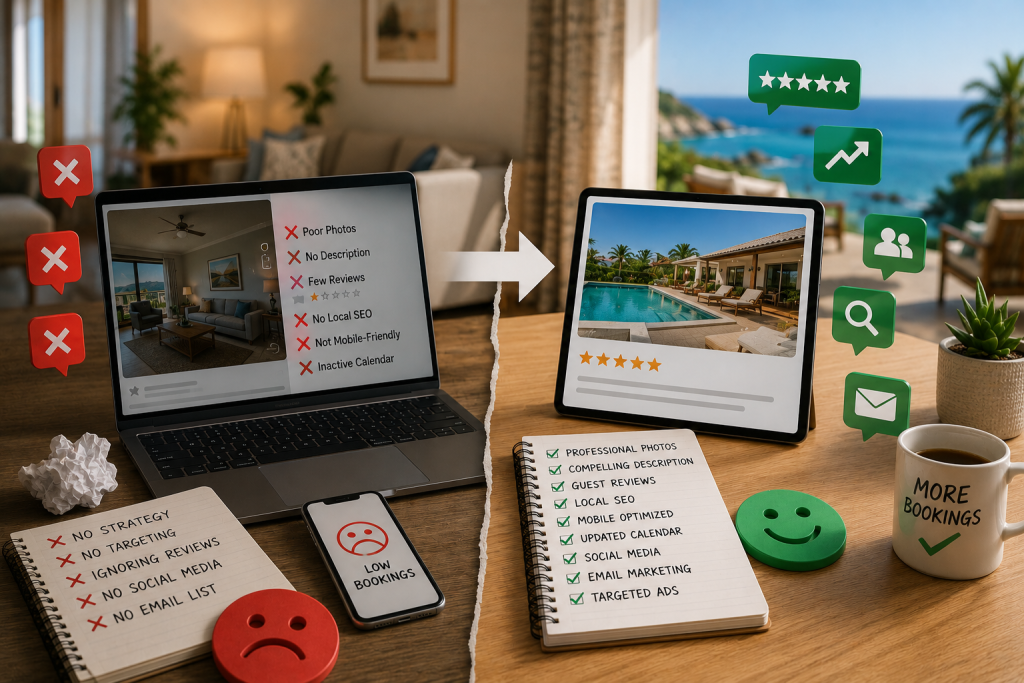
The most costly vacation rental marketing mistakes are not dramatic failures. They are quiet, persistent gaps that cost bookings month after month without the operator ever seeing a specific moment where things went wrong. The seven most common are: spreading across too many OTAs without a channel manager, having no clear unique selling point that differentiates the property, ignoring the guest database after checkout, operating a direct booking site that does not convert, inconsistent or absent social media presence, not tracking which channels actually drive bookings, and treating Airbnb SEO as disconnected from overall marketing strategy. Each mistake is fixable. Most require a systems change, not a budget increase.
Marketing gets blamed when bookings fall short, but the root cause is usually not a lack of marketing effort. It is a pattern of quiet mistakes that individually seem minor and collectively cost significant revenue over time.
Marketing was the top response for “what got harder in 2025” among vacation rental operators, with rising acquisition costs, declining listing site performance, and more difficulty driving direct traffic all cited across portfolio sizes. In that environment, fixing the mistakes that are quietly draining your marketing effectiveness matters more than adding new channels. Here are the seven most expensive ones.
Mistake 1: Spreading across too many OTAs without a channel manager
What it looks like: Listings on five or six platforms, each managed separately. Calendar updates happen manually. A booking comes in on Booking.com that does not get blocked on Vrbo for six hours. A double booking follows. The platform penalizes the account. The fix creates more admin work than the original listing was worth.
Why it happens: More platforms feels like more visibility. And it is, but only if the operational infrastructure to manage them exists. Without a channel manager that synchronizes availability across all platforms in real time, each additional OTA adds disproportionate operational risk.
The fix: Select the two or three platforms that generate the most bookings for your market and property type. Add a channel manager that keeps availability, pricing, and content synchronized automatically. Then add additional platforms only when the channel manager makes adding them operationally trivial. The goal is maximum distribution with zero calendar risk, not maximum listing count. Hostfully’s channel manager handles this across Airbnb, Vrbo, Booking.com, and your direct booking site from a single dashboard.
Mistake 2: No clear unique selling point
What it looks like: A listing that describes the property accurately but gives no specific reason why a guest should choose it over the 40 other comparable listings in the area. The photos show a clean, well-furnished property. The description says it is perfect for families or romantic getaways. The price is mid-market. Nothing distinguishes it.
Why it happens: Most operators describe the property rather than the experience. The features are listed, the amenities are itemized, but the specific reason this property fits this guest for this trip is never stated.
The fix: Identify the one or two things your property does better than any comparable listing in your market. Not “we have a hot tub” because every listing in your comp set probably has a hot tub. The view from that hot tub at sunset. The fact that the property is the only one in the area that sleeps 12 without putting anyone on a sofa bed. The working studio space that remote workers who have stayed there keep mentioning in reviews. Build your listing title, first description paragraph, and primary photos around that specific differentiation. As Katie Valentine frames it: “It’s not enough to have a nice cabin anymore, you need a story and a clear point of view.”
Mistake 3: Ignoring your guest database after checkout
What it looks like: Guests have a great stay, leave a five-star review, and the operator never contacts them again. The next time those guests want to visit the same destination, they open Airbnb and search from scratch, possibly booking a competitor’s property.
Why it happens: Most operators focus on acquiring the next booking, not on retaining the relationship with the last guest. OTAs actively discourage relationship continuity by keeping guest contact information on the platform. The result is a guest database that is never built because the operator never had the information to build it.
The fix: Build your guest email list through off-platform touchpoints: StayFi for Wi-Fi email capture, Hostfully’s Digital Guidebook splash screen for email collection with guest consent, and your own direct booking confirmations. Then use that list. A quarterly email to past guests with a direct booking offer, a seasonal update, or a “we’d love to have you back” message with a small discount generates repeat bookings from an audience that already trusts you. The cost of acquisition on a past guest is near zero. The cost of ignoring them is every future booking they would have made. If you manage a small portfolio of under 10 properties, personal follow-up is often more effective than email automation at this stage.
Mistake 4: A direct booking site that does not convert
What it looks like: The site exists. It looks professional. Traffic comes in from the post-checkout email campaign and the occasional Google search. But the conversion rate is near zero, and the operator concludes that direct bookings do not work for their business.
Why it happens: A direct booking site that does not display total pricing, that requires a guest to leave the site to complete the booking, that looks broken on mobile, or that has no visible social proof from past stays will not convert visitors regardless of how much traffic it receives.
The fix: Test your own booking flow on a mobile device. Can you find a property, check availability, see total pricing including all fees, and complete a booking in under three minutes? If not, the conversion problem is in the experience, not the traffic. The specific fixes are: an embedded booking engine that keeps guests on your domain, total pricing display before checkout, verified OTA reviews displayed on the site, and a mobile layout that works on any phone. For a full breakdown of what a converting direct booking site requires, see our vacation rental website design guide.
Hostfully data
Operators with 20 or more listings use an average of 3.1 direct booking tactics compared to 1.6 for operators with under 10 properties. The gap is not budget. It is systems. A converting direct booking site is the foundation that every other direct booking tactic depends on. Source: Hostfully 2025 Hospitality Trends Report.
Mistake 5: Inconsistent social media with no strategy
What it looks like: A business Instagram account with 14 posts, the most recent from eight months ago. Or a Facebook page that exists but has no followers because nothing has been posted in two years. Or an active account that posts beautiful photos of the property but never tells anyone how to book.
Why it happens: Social media for a vacation rental business feels like it should be simple but turns out to be surprisingly time-consuming to do consistently. Without a clear purpose, the effort feels unrewarded and stops.
The fix: Choose one platform, the one where your target guest is most likely to be searching for travel inspiration. For most vacation rental markets, that is Instagram. Commit to one post per week minimum. The content formula that works is simple: one-third property and amenity photography, one-third local destination content (the view, the nearby hike, the restaurant your guests keep mentioning), one-third guest experience highlights (reviews, user-generated photos, the kind of moments your property enables). Every post should include a direct booking link in the bio or a call to action to “book direct and save.” An inactive social account is not neutral. Guests who find it see a signal that the business may not be active.
Mistake 6: Not tracking which channels drive your bookings
What it looks like: An operator spending time on Instagram, running a Google ad campaign, sending email newsletters, and maintaining four OTA listings, with no clear picture of which activities generate actual bookings. The marketing budget and effort are distributed across channels by feel rather than by data.
Why it happens: Attribution in vacation rental marketing is genuinely hard. A guest might discover the property on Airbnb, search for it on Google, find the direct booking site, and then book after receiving the post-checkout email from a previous stay. Which channel gets credit?
The fix: Start with the simplest attribution available. Your PMS booking reports should show you the source of every confirmed reservation. Set up Google Search Console and Google Analytics on your direct booking site so organic search traffic and conversion behavior are visible. Ask guests who book direct how they heard about you. Over time, a clear picture of which channels generate bookings emerges, and marketing effort can be allocated accordingly. Operators who track attribution consistently find that two or three channels drive the vast majority of their bookings, and they can stop wasting effort on channels that do not contribute.
Mistake 7: Treating Airbnb SEO as separate from your overall marketing
What it looks like: An operator who thinks about Airbnb ranking as a platform-specific problem and direct booking marketing as a separate initiative. The two strategies are managed in silos. Improving Airbnb review scores and the direct booking email campaign are treated as unrelated projects.
Why it happens: The mental model of “Airbnb marketing” versus “direct booking marketing” makes them feel like different disciplines. They are not. They are the same customer moving through different stages of a relationship with your business.
The fix: Treat every Airbnb stay as step one in a direct booking funnel. High Airbnb ranking brings new guests in. Great guest experience generates the reviews that maintain that ranking. Post-checkout automation converts those guests into direct bookers for their next stay. The same PMS that automates your Airbnb messaging also sends the post-checkout direct booking offer. The same guest review that improves your Airbnb SEO is displayed on your direct booking site to convert first-time visitors. The systems are connected. Treat the strategy that way too. For the complete direct booking strategy, see our guide to getting direct bookings for your vacation rental.
Frequently asked questions about vacation rental marketing mistakes
What are the most common vacation rental marketing mistakes?
The most costly vacation rental marketing mistakes are: listing on too many OTAs without a channel manager to prevent double bookings, having no clear unique selling point that differentiates the property from competitors, ignoring the guest database after checkout rather than building repeat business, operating a direct booking site that does not convert visitors into bookings, maintaining inconsistent or inactive social media accounts, failing to track which channels actually drive bookings, and treating Airbnb SEO as separate from the overall direct booking strategy.
How do I know if my vacation rental marketing is working?
Vacation rental marketing effectiveness is measured by booking source attribution, occupancy rate relative to market comparables, direct booking percentage of total reservations, cost per acquired booking by channel, and repeat guest rate. Your property management system should track booking sources for every confirmed reservation. Google Search Console and Google Analytics track organic search traffic and conversion behavior on the direct booking site. Operators who track these metrics consistently can identify which channels generate bookings and allocate marketing effort accordingly.
How do I get repeat guests to my vacation rental?
Getting repeat guests requires three things: an exceptional stay experience that makes guests want to return, a way to stay in contact with them after checkout, and a clear reason to book direct next time. The practical implementation is: collect guest email addresses through property Wi-Fi capture or digital guidebooks, send a post-checkout email with a direct booking link and a small discount for future stays, and send a quarterly email to the full guest list before high-demand periods. Guests who receive a personal, timely offer convert at significantly higher rates than guests who are left to re-discover the property on Airbnb.
What makes a vacation rental stand out on Airbnb?
A vacation rental stands out on Airbnb through distinctive professional photography, a listing title and description that lead with a specific differentiated selling point, competitive pricing using a dynamic pricing tool, a high volume of positive reviews, Superhost status or equivalent performance metrics, and accurate amenity listings that appear in filtered searches. The underlying differentiator is a property experience that is specific and memorable enough to generate five-star reviews that describe it clearly.
How much should a vacation rental owner spend on marketing?
A useful benchmark is comparing the cost of any marketing channel against the OTA commission it replaces. If a direct booking channel costs 5% of revenue to maintain and generates bookings that would otherwise pay 15% in OTA commissions, the net benefit is 10% of that revenue. Most operators find that the highest-return marketing investment is operational: a PMS that automates review requests, response times, and post-checkout emails generates marketing outcomes at near-zero ongoing cost.
Key takeaways
- None of these mistakes announce themselves. No single checkout goes visibly wrong. The cost compounds silently across months of bookings until the operator looks at their direct booking share or their OTA commission line and wonders why the numbers aren’t moving.
- Six of the seven mistakes described here are solved by the same category of fix: a PMS with a channel manager, automated post-checkout triggers, a converting direct site, and basic attribution tracking. The investment is operational, not promotional.
- Ignoring the guest database is the most quietly expensive mistake. Every past guest who re-books through Airbnb instead of direct costs OTA commissions on a relationship the operator already earned.
- Airbnb SEO and direct booking strategy are not separate disciplines. The guest relationship that begins on Airbnb is the foundation of a direct booking channel when the right follow-up systems are in place.
- Track what drives your bookings. Marketing effort allocated by feel rather than by data produces the slowest improvements. Even basic attribution tracking from your PMS and Google Search Console reveals which channels deserve more investment and which are wasting time.
Fix the marketing mistakes that are quietly costing you bookings
Hostfully’s PMS includes a channel manager, direct booking site, automated post-checkout triggers, Digital Guidebook email capture, and unified inbox, covering most of the fixes described in this guide. Book a demo to see how it works.