

Property management software built for growth unifies distribution, operations, automation, and reporting into a single system so portfolios can expand without proportional increases in staff workload. The core capabilities that separate scalable software from basic tools are real-time multi-channel sync, a centralized calendar across all listings, trigger-based automation for guest communication and task management, and owner reporting that generates automatically. Property managers who standardize operations inside a single platform before scaling consistently report lower error rates, faster onboarding of new properties, and more predictable revenue performance as portfolio size increases.
Most property management software keeps up with a small portfolio. Far fewer hold up when that portfolio doubles. The gap shows up around 15 to 20 properties: calendars fall out of sync, guest messages pile up, owner reports eat an entire day you don’t have. The systems that worked at five listings start creating friction at fifteen, and by thirty they become the thing slowing growth down. Property managers who scale without burning out aren’t working harder than everyone else. They’ve built infrastructure that handles the repetitive layer so they can stay focused on growth. This guide covers exactly what that infrastructure looks like: channel management, operational visibility, automation, reporting, and smart access.
What does property management software need to support real portfolio growth?
Growth-oriented property management software has to do more than store reservations. It has to eliminate the operational drag that compounds when portfolio size increases.
The clearest way to evaluate any PMS for scale is to ask what happens when you add ten properties tomorrow. If the answer involves more manual steps, more coordination overhead, or more staff time per property, the software isn’t built for growth. Scalable platforms are designed so that adding a property activates the same proven system, not a new category of manual work.
The five capabilities that matter most at scale are:
- Multi-channel sync: Real-time availability and rate updates across all OTAs, with no manual intervention required
- Centralized calendar: One operational view of every listing, every reservation, and every team task
- Trigger-based automation: Guest messaging, task assignment, and internal notifications that fire without human initiation
- Owner reporting: Revenue breakdowns, payout tracking, and owner statements that generate automatically
- Smart device integration: Automated access code management that removes check-in coordination from the team’s plate entirely
Each of these capabilities compounds the others. Automation only works cleanly when the calendar is accurate. Reporting only stays manageable when data flows from a single system. Distribution only scales when rates and availability are managed centrally. Getting any one of them right while leaving the others disconnected creates a ceiling you’ll hit again.
How does channel management affect portfolio growth?
Channel management is the foundation of distribution, and distribution is where revenue growth begins.
When availability, rates, and reservations aren’t synchronized across platforms in real time, the operational consequences scale with portfolio size. Double-bookings require resolution. Inconsistent rates create guest confusion and review risk. Manual updates across platforms burn team time that should go toward growth decisions. OTA accounts face penalties when availability gaps create booking errors.

A property management system with native, real-time channel sync eliminates that category of problem. When a reservation comes in on any channel, availability is blocked everywhere else immediately. Rate adjustments made in one place propagate across all connected OTAs without additional steps.
For property managers expanding into new channels or new markets, this changes the economics of growth. Adding a platform or a new listing doesn’t add a new set of manual processes. It activates the same centralized system across a wider surface area. Will Asbury of Guesthoo describes the shift directly: once reliable channel sync was in place, he expanded from Airbnb to Vrbo and his direct booking site, and vacancy rates dropped immediately. Guesthoo scaled 12x to 60 listings with zero new full-time hires using Hostfully’s channel management and automation.
OPM — 15 to 63 listings, 0% double-booking rate
OPM grew from 15 to 63 listings and achieved a 0% double-booking rate by centralizing all channels in Hostfully’s automated calendar. Read the full story
Why does a centralized calendar matter more as portfolio size increases?
Operational visibility is a prerequisite for growth. Without a single source of truth, teams waste time reconciling information across disconnected tools.
At small portfolio sizes, multiple calendars and spreadsheets are workable. At 20 or 30 properties, they become a liability. Errors increase. Coordination takes longer. Decisions get made on incomplete information. The time spent just maintaining clarity about what’s happening across the portfolio becomes a meaningful drag on what the team can accomplish. “I didn’t want to rebuild my stack at property twelve” is a phrase that comes up repeatedly among operators who made the infrastructure decision early.

A centralized calendar consolidates every reservation, every listing, and every team task into one operational view. Managers can switch between portfolio-wide and filtered views, drag and drop reservations, adjust pricing, block dates, and coordinate cleaning and maintenance without switching between systems.
The compounding effect is significant: more properties add more moving parts, but a unified calendar means that additional complexity doesn’t require proportional increases in management time. Rick Armour of RJA Vacation Rentals manages 18 listings across three countries from a single Hostfully calendar. He describes the central calendar as the tool that keeps him aligned even when he’s conducting business from a boat off the coast of British Columbia. His portfolio grew 39% in revenue despite a regulatory cut that eliminated 30% of his listings.
UNWR — three micro-brands, one calendar, 20 hours saved per week
Ramona Rentals scaled from 3 to 29 properties in two years using Hostfully as its central operations hub. UNWR unified three micro-brands and eight booking sites into one centralized calendar, saving 20 hours a week and eliminating manual updates. Read the UNWR case study
How do automations prevent burnout when managing more properties?
Automation is the mechanism that separates linear growth from exponential growth. Without it, every new property adds proportionally more work to the team.
The manual tasks that consume the most time at scale are also the most predictable: booking confirmations, check-in instructions, day-of messages, post-stay review requests, cleaning coordination, and maintenance scheduling. These tasks happen at fixed, predictable points in every reservation lifecycle. That predictability is exactly what makes them automatable.
Property management software with a strong automation engine lets operators build trigger-based workflows that execute these tasks automatically. Dynamic fields pull reservation details into messages without manual entry. Task assignments for cleaning and maintenance fire on checkout confirmation. Review requests send within the optimal window without anyone initiating them.
The operational result is that a team’s workload doesn’t expand at the same rate as the portfolio. Will Asbury of Guesthoo put it plainly: “Hostfully is the reason I could grow Guesthoo without hiring staff. At this scale, automation isn’t optional, it is the business.” He scaled from 5 properties to 60 with zero new full-time hires, cutting the time he spent on guest messaging by 90%.
Hey Comfort — 6 to 50 properties in 6 months, revenue up 25%
Hey Comfort scaled from 6 to 50 properties in 6 months and increased revenue by 25% through full Hostfully Automations. HostWell saved 20 hours per week by using Hostfully to resolve messaging chaos, freeing the team to focus on growth. Read Hey Comfort’s story
See it in action
See how Hostfully’s property management tools work across channel management, automation, and reporting.
What role does owner reporting play in scaling a property management company?
Owner reporting is a growth lever that most property managers underestimate until it breaks.

Owners make referrals based on trust. Trust is built through consistent, accurate, and timely financial reporting. A property management company that sends clear monthly statements builds the kind of owner confidence that drives portfolio growth through referrals. A company that sends late, confusing, or manually assembled reports creates friction at the source.
As the portfolio grows and properties are distributed across multiple OTAs, the manual work required to reconcile payout data, calculate owner shares, and format statements scales badly. What takes an hour at ten properties can take an entire day at forty. Jay Ullrich of Select Stays described the wall clearly: “We were already at 15 units and about to onboard seven more when we hit a wall. We needed better reporting.”
| Reporting capability | Why it matters at scale |
|---|---|
| Revenue breakdowns by property and owner | Owners can verify performance without requesting separate data |
| Portfolio-wide performance views | Managers identify underperforming properties quickly |
| Payout tracking | Reduces reconciliation time across multiple OTAs |
| Owner statements | Automated generation removes monthly manual prep |
| Customizable formulas | Handles varied commission structures without workarounds |
Automated reporting tools inside a PMS generate revenue breakdowns by property, payout tracking, and fully formatted owner statements on a consistent schedule. Select Stays now runs reports for 45 properties in 10 minutes. Their owners can see every dollar, from guest revenue to cleaning fees to expenses, without needing a walkthrough. “The structured reporting has eliminated owner inquiries and built trust,” Jay said. “That trust has been a big win.” Read the Select Stays story.
Twinity — 100 properties, reporting time cut by 50%
Twinity grew to 100 properties while saving four or more days each month, cutting reporting time by 50% with automated, customizable formulas. Read the Twinity story
How does smart lock integration support growth and better guest reviews?
Smart device integration removes one of the most time-consuming and review-sensitive friction points in property management: check-in coordination.
Late arrivals, confusing key exchanges, and lockboxes that fail create stress for guests and burn team time. Each check-in meetup is time that could be spent onboarding a new property or resolving a higher-leverage problem. When a portfolio scales without addressing check-in, the time cost grows proportionally with every reservation added.
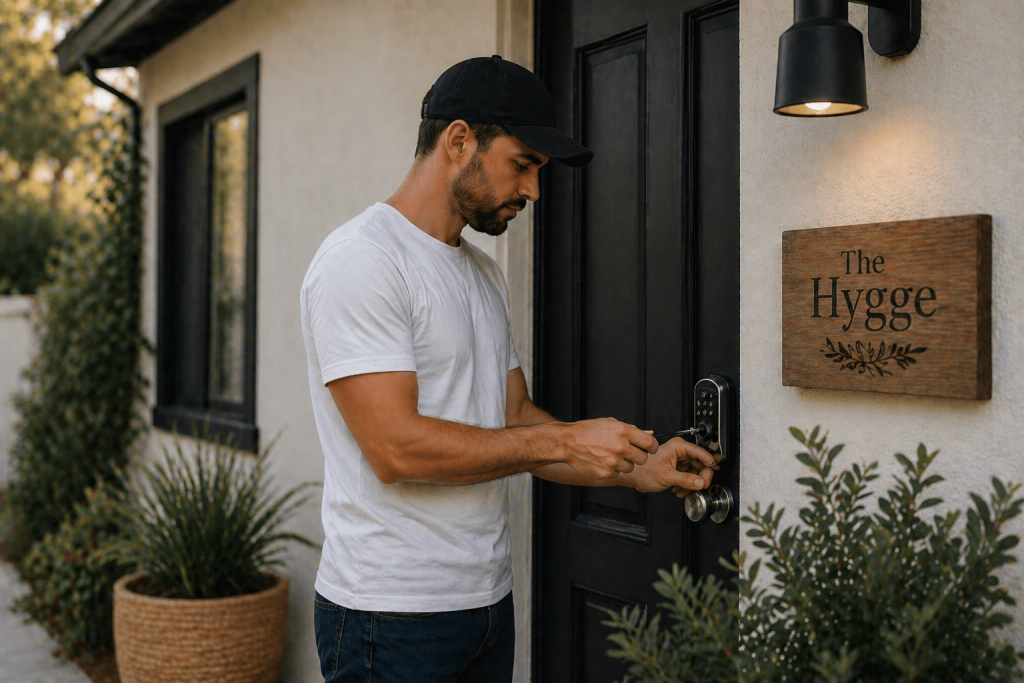
Smart lock management integrated directly into the PMS eliminates that problem. Access codes are generated automatically when a reservation is confirmed, tied to the specific dates of the stay, and sent to guests through the same messaging automation that handles check-in instructions. When the reservation ends, access is revoked automatically.
The guest experience consequence is equally important. Self-check-in with a confirmed, personalized access code delivered via professional pre-arrival messaging produces consistently better reviews than coordination-dependent alternatives. Reviews compound over time and drive both organic OTA visibility and direct booking conversion.
Properties by Preston — 1 to 718 rentals in two years
Properties by Preston grew from 1 to 718 rentals in two years using Hostfully Smart Locks to automate listings, access, and operations. Wydaho consistently earns 5-star reviews by automating secure, time-bound smart lock access through one centralized system. Read the Properties by Preston story
Frequently asked questions about property management software for growth
What is the difference between a basic PMS and a growth-focused PMS?
A basic property management system handles reservation storage, calendar display, and simple guest messaging. A growth-focused PMS integrates channel management, automation, owner reporting, and smart device management into a single platform so that adding properties doesn’t require adding proportional manual work. The practical difference becomes visible at 15 to 20 properties, when fragmented systems begin creating more operational drag than they resolve.
How many properties can a property management team handle with the right software?
There’s no fixed ceiling, but the inflection point where software capability determines team capacity typically falls between 15 and 30 properties. Below that range, spreadsheets and disconnected tools are manageable. Above it, operators with unified platforms and strong automation typically report managing portfolios of 50 to 200 properties with teams that would be undersized without those tools.
Does channel management software prevent double-bookings?
Real-time channel sync prevents double-bookings by updating availability across all connected OTAs the moment a reservation is confirmed on any platform. The key requirement is that the sync be genuinely real-time rather than batched on a delay. Batched sync creates a window where two reservations can be accepted for the same dates before the block propagates. Native integrations with OTAs as preferred partners typically produce the most reliable sync performance.
How much time does automation actually save in vacation rental management?
Time savings from automation depend on portfolio size and the number of manual touchpoints being replaced. Documented results from property managers using Hostfully’s automation tools include 20 hours per week saved at mid-sized portfolios and a 90% reduction in guest messaging time at 60 properties. The highest-impact automations are guest messaging sequences and cleaning task assignments, both of which happen on every reservation and scale directly with booking volume.
What should be in an automated owner report for short-term rentals?
A complete owner report should include gross revenue for the period, platform fees and deductions, management commission calculation, net owner payout, and a per-property breakdown when an owner holds multiple listings. Reports generated automatically from the PMS are more accurate than manually assembled spreadsheets because they pull directly from reservation and payout data without manual entry steps.
Is it possible to manage multiple brands under one property management system?
Yes, and doing so is a significant operational advantage. Property managers operating multiple brands or sub-brands benefit from consolidating all listings into a single PMS with unified calendar and reporting views, even when guest-facing experiences and listing names are differentiated. Consolidated operations reduce the coordination overhead of managing separate systems for each brand and enable consistent automation and reporting across the full portfolio.
When does a property management company need to upgrade its software?
The clearest signals that a PMS is limiting growth rather than enabling it are: double-bookings or near-misses occurring regularly, owner reporting taking more than two to three hours per month per owner, guest communication requiring daily manual attention, and the team’s capacity to onboard new properties being constrained by software limitations rather than sales or business development capacity.
Key takeaways
- Growth in property management is primarily an infrastructure problem. Operators who scale fastest build systems that add capacity without proportional headcount increases.
- Real-time channel sync is the non-negotiable foundation of distribution. Batched or manual sync creates double-booking risk and limits the number of platforms a team can manage effectively.
- Automation determines whether portfolio growth leads to team burnout or sustainable expansion. Operators who automate guest messaging and cleaning coordination consistently report 12x to 50x portfolio growth without adding full-time staff.
- Automated owner reporting improves owner trust and referral rates, which are often the primary growth levers for property management companies at the 20 to 100 property range.
- Smart lock integration removes check-in friction and produces measurable improvements in review scores, which compound over time into better OTA visibility and direct booking conversion.
See how far your portfolio can go with the right infrastructure
Property managers using Hostfully report portfolio growth of 12x to 50x without adding full-time staff. Book a demo and see how it works.