
TL;DR
A Vrbo rental agreement is a legally binding contract between the host and guest that outlines property rules, payment terms, cancellation policies, damage procedures, and occupancy limits. Vrbo allows hosts to upload custom agreements as PDFs to each listing, and guests can review them before booking. The agreement must comply with platform policies and local regulations. House rules on the listing page take priority over the rental agreement in disputes, so both documents must stay consistent. Every property should have its own agreement, and hosts should collect digital signatures before check-in to ensure both parties are protected.
A guest breaks a lamp, denies it, and Vrbo sides with them because your house rules didn’t match your rental agreement. That kind of preventable loss turns a profitable booking into a write-off. A Vrbo rental agreement sets expectations before the stay begins, protects your property when things go wrong, and signals to families booking your listing that you run a professional operation. This guide covers what to include in your agreement, how to upload it, and how to automate signatures so the paperwork doesn’t become another tax on your time.
This article is educational and not legal advice. Hosts should consult a local attorney familiar with short-term rental regulations before finalizing any rental agreement.
Does Vrbo allow rental agreements?
Yes. Vrbo explicitly supports rental agreements and provides tools for hosts to upload them directly to each listing. Guests can review the agreement before they book, which means they’re agreeing to your terms from the start.
There are a few rules to keep in mind. Your rental agreement must be uploaded as a PDF. It must comply with Vrbo’s platform policies and local laws, which means you can’t include terms that contradict what Vrbo already requires. For example, you can’t demand a separate security deposit if your listing already uses Vrbo’s damage protection.
The most important detail: Vrbo’s house rules (the ones visible on your listing page) take priority over your rental agreement in any dispute. If your agreement says one thing and your house rules say another, Vrbo will defer to the house rules. That’s why both documents must stay perfectly aligned.
Why do you need a Vrbo rental agreement if there are already house rules?
House rules cover how guests should treat your property. A rental agreement covers the legal and financial framework of the entire stay. They serve different purposes, and relying on one without the other leaves gaps.
Legal Manager at Faster Draft, Daria Turanska, puts it clearly: “We recommend creating your own agreement rather than relying solely on Vrbo’s internal policies. Vrbo platform terms cover rules, but often don’t address unique local laws or specific landlord-tenant nuances. A tailored agreement protects both hosts and guests more comprehensively.”
Tim Choate, Founder of Red Awning, agrees from the operator side: “Although Vrbo’s policies serve as a good starting point, I really think every professional host or operator should have their own rental agreement. The Vrbo framework is designed for consistency; your contract is designed for clarity. The two are not the same.”
Vrbo rental agreement vs house rules
These two documents serve different functions. Here’s how they compare.
| Rental agreement | House rules | |
|---|---|---|
| Document type | Legal contract signed by both parties | Behavioral guidelines displayed on listing |
| Scope | Financial terms, liability, cancellation, occupancy, local law compliance | Noise, pets, smoking, cleaning, amenity use |
| Delivery | Uploaded as PDF; signed separately before or at check-in | Visible on Vrbo listing page before booking |
| Legal weight | Enforceable in court as a signed contract | Sets expectations but limited enforcement outside Vrbo |
| Dispute priority | Vrbo defers to house rules if the two conflict | Takes priority on the platform in case of inconsistency |
Think about the difference between a remote mountain cabin and a downtown apartment. The cabin might need terms about firewood handling and snow removal. The city unit probably needs noise ordinances, building access protocols, and parking instructions. Both fall under Vrbo’s general policies, but their day-to-day risks are completely different. A rental agreement lets you address those specifics.
What happens if you don’t use a rental agreement?
Operating without a guest agreement means you’re relying entirely on Vrbo’s platform policies and your listing-level house rules. That’s a thin safety net when real money is on the line.
Payment disputes
Without a signed vacation rental contract specifying the total cost breakdown, guests can challenge charges they claim they didn’t agree to. Vrbo will look at what’s documented, and if your only documentation is a listing page, you’re at a disadvantage.
Damage claims
If a guest breaks something and you don’t have a signed agreement outlining liability, recovering costs relies entirely on Vrbo’s damage protection. That coverage has limits, and claims without supporting documentation are more likely to be denied or reduced.
Unauthorized parties
A host agreement with a clear occupancy clause gives you a written basis to enforce guest limits. Without one, you’re left arguing that the guest “should have known” your expectations.
Insurance complications
Many STR insurance providers require hosts to maintain a written short-term rental agreement as a condition of coverage. If you file a claim and can’t produce a signed document, your insurer may reduce or deny the payout.
Platform arbitration limits
Vrbo’s dispute resolution process favors documented evidence. A signed vacation rental lease agreement carries more weight than a verbal understanding or an informal message thread.
What should a Vrbo rental agreement include?
A strong Vrbo rental agreement covers every scenario where a misunderstanding could turn into a dispute. Here’s a clause-by-clause breakdown of what to include.
Essential Vrbo rental agreement clauses at a glance
| Clause | Why it matters |
|---|---|
| Party information | Documents who is staying and provides emergency contact details |
| Property details | Sets clear expectations about rooms, beds, and amenities |
| Stay dates and check-in/check-out | Prevents early arrivals and late departures that disrupt turnovers |
| Occupancy limits | Prevents unauthorized guests and protects against party risk |
| Payment terms | Clarifies all charges and due dates to reduce billing disputes |
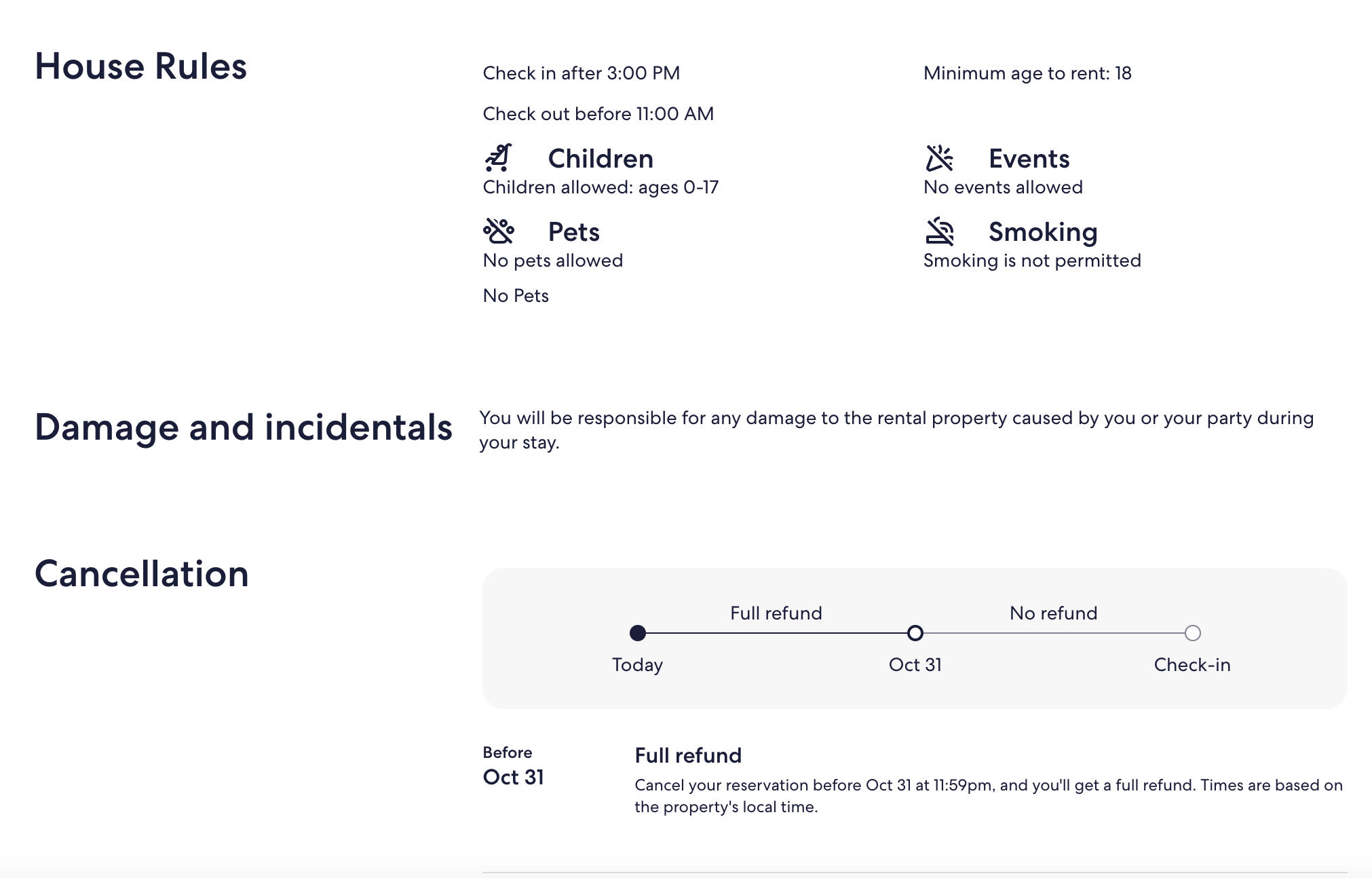
| Cancellation policy | Reduces refund disputes by matching Vrbo’s stated tier |
| House rules | Sets behavioral expectations for noise, pets, smoking, and cleaning |
| Damage policy | Defines liability for breakage and explains the claims process |
| Local laws | Demonstrates compliance and builds guest trust |
| Force majeure | Covers emergencies, natural disasters, and extraordinary cancellations |
| Signatures | Makes the vacation rental contract legally enforceable |
Example A: Casual, host-driven tone
This style works well for cabins, beach homes, tiny homes, and properties where the host relationship is more personal and conversational.
Vacation Rental Agreement
Thanks for booking our home. We’re excited to host you and want everyone to have a smooth, relaxing stay. This agreement helps set clear expectations for both sides.
Guest information
Primary guest: [Guest Name]
Phone/email: [Contact Info]
This reservation is for a maximum of 6 guests total.
Property details
Property address: [Property Address]
The home includes:
- 3 bedrooms
- 2 bathrooms
- Full kitchen
- Hot tub
- Backyard patio
Stay dates and check-in/check-out
Check-in: After 4 PM
Check-out: Before 10 AM
If you need flexibility, send us a message ahead of time and we’ll do our best to accommodate.
Payment terms
Your reservation total includes:
- Nightly rate
- Cleaning fee
- Applicable taxes
- Pet fee (if applicable)
All payments are processed securely through Vrbo.
Cancellation policy
Our cancellation policy follows the terms listed on the Vrbo booking page. Please review those carefully before booking.
House rules
Please treat the home with care and respect our neighbors.
- Quiet hours: 10 PM to 8 AM
- No parties or events
- No smoking indoors
- Approved pets only
- Registered guests only
Before checkout, we ask guests to:
- Start the dishwasher
- Place used towels in the bathroom
- Lock doors and windows
Damages
Accidents happen. If something breaks or gets damaged, just let us know as soon as possible so we can sort it out fairly.
Guests may be responsible for damages beyond normal wear and tear.
Local rules
Guests agree to follow all local laws, parking restrictions, and community noise ordinances during their stay.
Force majeure
We are not responsible for cancellations or interruptions caused by severe weather, natural disasters, power outages, government restrictions, or other events outside our control.
Example B: Formal, professionally managed tone
This style is more common among larger vacation rental managers, luxury properties, and operators managing homes on behalf of owners.
Short-Term Vacation Rental Agreement
This Vacation Rental Agreement (“Agreement”) is entered into between the Property Manager (“Manager”) and the Registered Guest (“Guest”) for the temporary rental of the property identified below.
1. Guest information
Primary Guest Name: [Guest Name]
Reservation Number: [Reservation ID]
Guest acknowledges responsibility for all occupants and visitors associated with this reservation.
2. Property details
Rental Property Address: [Property Address]
The property includes all furnishings, fixtures, appliances, and amenities currently located on-site unless otherwise specified.
3. Reservation term
Check-in date: [Date]
Check-out date: [Date]
Standard check-in time is 4:00 PM. Standard check-out time is 10:00 AM.
Unauthorized late departures may result in additional fees.
4. Occupancy limits
Maximum occupancy for this property is limited to six (6) registered guests unless otherwise approved in writing by Manager.
Unauthorized guests, parties, or events are strictly prohibited.
5. Payment terms
Guest agrees to pay all reservation charges, including:
- Rental fees
- Cleaning fees
- Taxes
- Pet fees (if applicable)
- Additional approved charges
Payments are processed according to Vrbo platform policies and payment schedules.
6. Cancellation policy
Cancellation terms are governed by the policy displayed on the Vrbo listing at the time of booking.
No refunds shall be issued outside the stated cancellation window unless required by law.
7. Property rules
Guest agrees to comply with all posted and written property rules, including but not limited to:
- Quiet hours from 10:00 PM to 8:00 AM
- No smoking or vaping inside the property
- No unauthorized events
- No illegal activity
- Proper use of hot tubs, pools, fireplaces, and outdoor amenities
Violation of property rules may result in termination of occupancy without refund.
8. Damage and liability
Guest assumes responsibility for any damage to the property or its contents occurring during the reservation period beyond normal wear and tear.
Guest agrees to report damage immediately.
Manager reserves the right to charge the payment method on file or pursue reimbursement for repair, replacement, excessive cleaning, or policy violations.
9. Compliance with local laws
Guest agrees to comply with all applicable local laws, HOA rules, parking regulations, occupancy restrictions, and noise ordinances.
10. Force majeure
Manager shall not be held liable for circumstances outside reasonable control including natural disasters, severe weather events, utility outages, pandemics, governmental actions, or other force majeure events.
Most operators land somewhere between these two. The right tone depends on your property type, your guest demographic, and whether you manage the home yourself or on behalf of an owner. What matters is that every clause from the table above is covered, regardless of how formally you phrase it.
Industry stat
The short-term vacation rental market was valued at $131.45 billion in 2025 and is forecast to reach $222.70 billion by 2030. As the market grows, insurance premiums for comprehensive STR policies have climbed steeply, making written agreements more important than ever for hosts who want to protect their investment without relying solely on platform coverage. (Source: Mordor Intelligence, 2025)
Hostfully PMS automates rental agreement delivery and digital signature collection for every booking. When a guest confirms a reservation, Hostfully sends the agreement automatically and tracks the signed document. See how it works.
How do you upload a rental agreement to Vrbo?
Vrbo requires rental agreements to be in PDF format. Each listing needs its own short-term rental agreement, so if you manage multiple properties, you’ll upload a separate document for each one.
Here’s the process:
- Log in to your Vrbo Owner Dashboard.
- Select the listing you want to add an agreement to.
- Click Property in the navigation menu.
- Select Rules & policies from the dropdown.
- Open the Rental agreement tab.
- Click Upload a rental agreement and select your PDF.
Once uploaded, guests can review the agreement before booking. If you use a channel manager to distribute listings across multiple platforms, make sure your agreement stays consistent everywhere. The Hostfully channel manager syncs listing details across Vrbo, Airbnb, and Booking.com so your policies don’t drift out of alignment.
How do you get guests to sign your Vrbo rental agreement?
Uploading the agreement to Vrbo makes it visible to guests, but it doesn’t guarantee they’ll sign it. For a legally binding signature, you need a separate process.
The most efficient approach is automating it through your property management software. With Hostfully, the workflow looks like this: a guest books through Vrbo, Hostfully automatically generates the rental agreement and sends it to the guest with a signature request, and the signed document gets stored alongside the reservation record. No manual follow-up required.
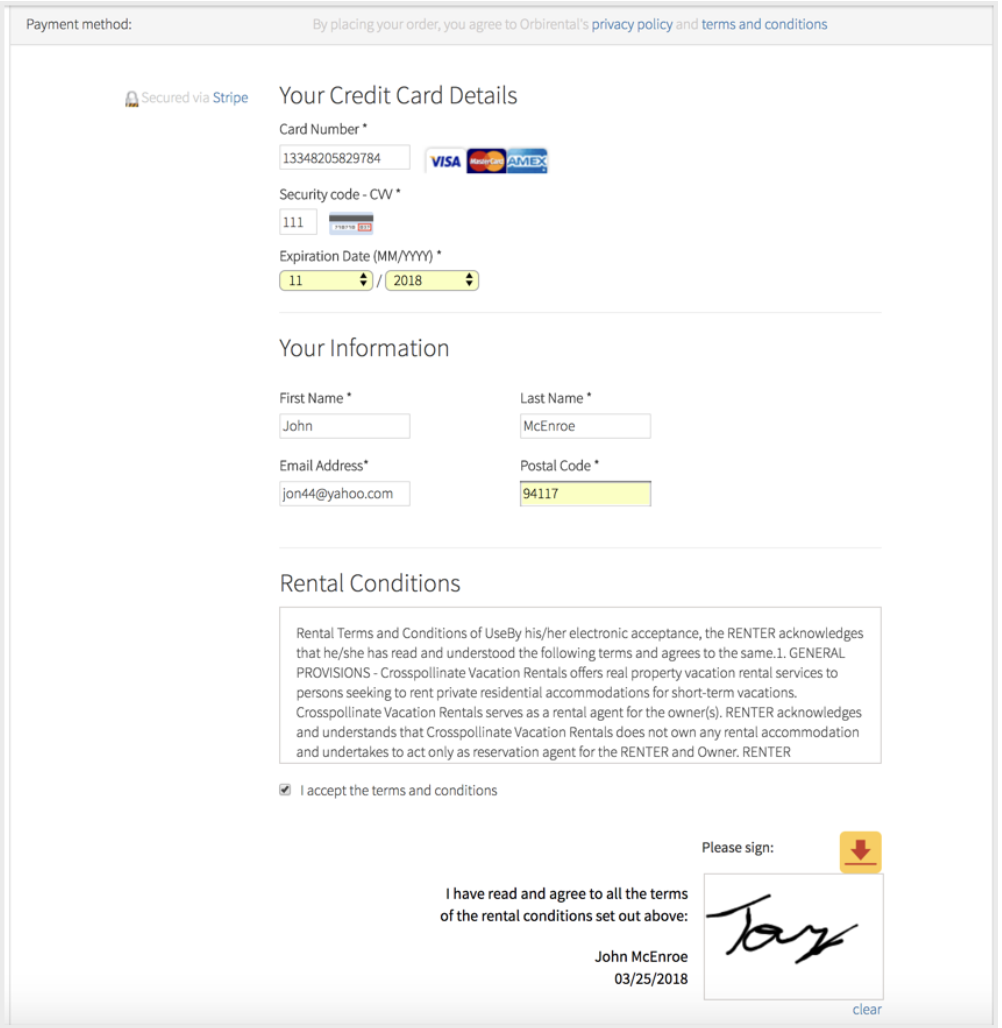
Turanska recommends framing the request as part of the guest experience rather than a legal hurdle: “Something like: ‘To ensure a smooth stay, please review and sign our rental agreement outlining important details.'”
If you manage properties without a PMS, you can use standalone e-signature tools like Dropbox Sign or DocuSign. The downside is manual tracking: you’ll need to send each agreement yourself and follow up if guests don’t sign before check-in.
What are the best practices for writing a vacation rental agreement?
The content of your agreement matters, but so does how you present it.
Use clear, plain language. This is a contract, but it doesn’t need to read like one. Avoid legal jargon so every guest can understand what they’re agreeing to. Have someone outside your business read the document and flag any confusing terms.
Keep your tone professional but welcoming. Choate recommends delivering the agreement through a branded digital form “positioned as being part of the guest experience rather than a legal barrier.” The goal is to make guests feel informed, not intimidated.
Review and update the agreement regularly. Vrbo’s policies change, local regulations shift, and your own house rules evolve. A yearly review (or whenever you notice a policy update) keeps your STR rental agreement aligned and legally sound.
If you’re not confident drafting the document yourself, invest in a legal review. A contract lawyer familiar with short-term rental law can draft or review your agreement for a one-time fee. That investment pays for itself the first time it prevents a dispute.
Frequently asked questions about Vrbo rental agreements
Is a Vrbo rental agreement legally binding?
Yes. A Vrbo rental agreement is a legally binding contract as long as it complies with both platform policies and local laws. Both parties agree to the stated terms, and signatures (digital or physical) confirm that agreement. If a dispute arises, the signed agreement serves as the legal reference point.
What’s the difference between a Vrbo rental agreement and house rules?
A rental agreement is a comprehensive legal document covering financial terms, cancellation policies, occupancy limits, liability, and more. House rules are a shorter set of behavioral guidelines displayed directly on your Vrbo listing. The rental agreement carries more legal weight for complex disputes involving payments, damages, or liability.
Can I use my own rental agreement on Vrbo?
Yes. Vrbo allows you to upload a custom rental agreement as a PDF to each listing. The only requirement is that your agreement doesn’t conflict with Vrbo’s platform policies or applicable local laws.
Does Vrbo provide a rental agreement template?
No. Vrbo does not provide a standard rental agreement template. Hosts are responsible for creating their own document. You can start with a vacation rental agreement template and customize it to match your property, local regulations, and business policies.
How do I add a rental agreement to my Vrbo listing?
Log in to your Vrbo Owner Dashboard, select your listing, navigate to Property, then Rules & policies, and open the Rental agreement tab. Upload your agreement as a PDF. You’ll need a unique agreement for each property you list.
What are the most important clauses in a Vrbo lease agreement?
At minimum, include: party information, property details, stay dates, occupancy limits, payment terms, cancellation policy, house rules, damage procedures, local law references, force majeure, and signatures. The more specific you are to your property’s unique risks, the stronger the agreement will be.
Can guests refuse to sign the rental agreement?
Guests can choose not to sign, but you can set the expectation upfront by noting the signature requirement in your listing description. If a guest books knowing a signed agreement is part of the process, refusal is rare. Some PMS tools let you make the signature a required pre-check-in task.
Do I need a different rental agreement for each property?
Yes. Vrbo requires a unique rental agreement for each listing. Even if your properties are similar, differences in local regulations, amenities, or house rules mean each agreement should be tailored.
Key takeaways
- Vrbo’s house rules override your rental agreement in disputes, so keep both documents aligned or the agreement won’t protect you when it matters.
- Operating without a signed agreement exposes you to payment disputes, damage claim denials, and insurance complications that a single document could prevent.
- Every clause (occupancy, payment, cancellation, damages, force majeure, signatures) should be tailored to your specific property, not copied from a generic template.
- Automating signature collection through a PMS removes the manual follow-up and keeps signed documents tied to each reservation.
- A yearly review catches Vrbo policy changes and local regulation shifts before they create misalignment.
Stop chasing signatures and start automating them
Every Vrbo booking gets the right agreement, sent automatically, signed before check-in, and stored with the reservation. Book a free demo to see how Hostfully handles it.