

OTA stands for online travel agency. An OTA is a website or app that allows users to search, compare, and book travel services — including hotels, flights, vacation rentals, and travel packages — all in one place. Well-known examples include Booking.com, Expedia, Airbnb, and Vrbo. In travel industry shorthand, “OTA meaning” and “OTA full form” both refer to this same category of platform.
TL;DR
For property managers, OTAs like Airbnb, Vrbo, and Booking.com serve as distribution channels that generate bookings in exchange for a commission on each reservation, typically between 3% and 20% of the booking value. Listing on multiple OTAs increases a property’s visibility across different traveler segments, reduces dependence on a single platform, and helps fill vacancy gaps year-round. Managing availability across channels simultaneously requires a channel manager to prevent double bookings.
You already know which platform accounts for most of your bookings. What most OTA guides skip is everything that happens next: why relying on that one platform is a revenue risk, how hotel OTAs and vacation rental OTAs operate by completely different rules, and what it actually takes to distribute across multiple channels without manufacturing a double-booking nightmare at 2am. Most guides on this topic are also written for hoteliers, not for property managers running a portfolio of STRs across multiple markets. This one isn’t. Whether you’re evaluating your first secondary channel or rethinking your entire distribution mix, here’s what you need to know.
What is an OTA, and how does it work?
An online travel agency (OTA for short) is a website or app that aggregates travel inventory from multiple providers and allows consumers to search, compare, and book accommodations in one place. The OTA full form (online travel agency) applies whether the platform focuses on hotels, vacation rentals, flights, or all of the above. In common usage, “OTA meaning in travel” and “what does OTA stand for” both refer to the same platform category.
For vacation rental operators, the mechanics work like this: you list your property on an OTA, upload photos, set rates, and define availability. The OTA indexes your listing alongside thousands of others, drives traffic through its own marketing budget, and charges you a commission when a booking is confirmed. The OTA handles payment processing and, in some cases, guest support. You receive the booking net of the platform’s fee.
The OTA’s core value to property managers is demand generation. These platforms spend heavily on paid search, TV advertising, and SEO to capture travelers at the point of intent. A property manager with 20 listings cannot match that spend independently, which is why OTAs remain a core distribution channel even for operators with strong direct booking programs.
How are OTAs different from traditional travel agencies?
Traditional travel agencies operated through human agents who booked travel on behalf of clients and earned a commission from suppliers. OTAs replaced most of that model with self-service technology.
The key differences that matter to property managers are speed and scale. A traditional agent represented a limited inventory set and booked sequentially. An OTA indexes millions of properties, personalizes results in real time, and completes transactions without human involvement. For operators, this means greater reach at the cost of control: the OTA owns the guest relationship up to check-in, shapes how your listing is presented, and sets the rules of the platform.
The second critical difference is data. Traditional agencies provided little insight into demand patterns. OTAs generate performance data that operators can use to adjust pricing, availability strategy, and listing optimization, though access to that data is filtered through each platform’s own analytics tools.

What types of OTAs exist?
OTAs are not limited to accommodation. The broader OTA category covers several distinct types of travel inventory, which is why “OTA meaning in travel” can refer to different platforms depending on the context.
- Hotel OTAs. Platforms like Booking.com, Hotels.com, and Expedia built their core inventory around hotel rooms. They are the oldest and largest OTA category by revenue.
- Vacation rental OTAs. Platforms like Airbnb and Vrbo list whole-home and short-term rental inventory. This is the category most relevant to professional property managers.
- Flight OTAs. Platforms like Kayak, Google Flights, and Skyscanner aggregate airline inventory. Some also bundle flights with accommodation.
- Package OTAs. Platforms like Expedia and Priceline offer bundled flight-plus-hotel or flight-plus-car deals. These attract price-sensitive leisure travelers booking complete trips in one transaction.
- Niche OTAs. Vertical-specific platforms serve distinct traveler segments: luxury properties (Plum Guide, Mr & Mrs Smith), pet-friendly stays, rural and off-grid accommodation, or specific geographic regions. Lower volume than the major platforms, but less competition and a more qualified guest audience.
For vacation rental operators, the practically relevant categories are vacation rental OTAs, hotel OTAs that have expanded into STR inventory (Booking.com, Expedia), and niche OTAs aligned with your property type. The rest of this guide focuses specifically on how OTAs work for short-term rental management.
What’s the difference between hotel OTAs and vacation rental OTAs?
Hotel OTAs and vacation rental OTAs share the same basic model but serve meaningfully different property types and guest expectations. Understanding the distinction matters because the major platforms increasingly serve both markets, and the rules, fee structures, and optimization levers differ substantially.
Hotel OTAs
Platforms like Booking.com, Expedia, and Hotels.com were built for hotel inventory. They are designed around standardized room types, rate plans, and cancellation policies that hotels have used for decades. Hotel OTAs typically charge the accommodation provider a commission of 15% to 25% and give the hotel more control over rate parity and room-level data.
Hotel operators tend to use OTAs alongside global distribution systems (GDS) and property management systems built for multi-room, multi-rate inventory. The relationship between hotel and OTA is typically more formalized, with contracted terms and account management at scale.
Vacation Rental OTAs
Vacation rental platforms, led by Airbnb and Vrbo, were built for unique, whole-property inventory. They are structured around single-unit listings with property-specific photos, descriptions, house rules, and host reviews. The guest experience is built around discovering a specific place rather than a room type within a category.
Key differences from hotel OTAs:
- Host vs. property focus. Vacation rental OTAs surface the host or property manager as part of the product. Reviews are tied to the host identity, not just the property address.
- Commission structures. Most vacation rental OTAs split the fee between host and guest (Airbnb charges hosts approximately 3% and guests a separate service fee). Some platforms charge a single host-side commission of 8% to 20%.
- Search algorithm mechanics. Vacation rental OTA algorithms reward listing completeness, response time, acceptance rate, and review velocity in ways that hotel OTAs do not.
- Booking windows. Vacation rental bookings tend to have shorter advance windows and longer minimum stay requirements than hotel bookings, which affects how you configure availability.
- Guest expectations. Vacation rental guests accept greater variability in property setup (no daily housekeeping, self-check-in, house rules) in exchange for space, privacy, and a lower per-night cost relative to hotels.
Both Booking.com and Expedia have expanded significantly into vacation rental inventory, meaning operators frequently list the same property on platforms originally built for hotels. Understanding which platform mechanics apply to your listing type is what separates operators who optimize well from those who apply hotel logic to STR distribution.
2025 Booking Channel Data
According to Hostfully’s 2025 Vacation Rental Industry Survey of 256 property managers, OTAs continue to dominate the booking mix: Airbnb accounts for 45% of bookings on average, followed by direct (20%), Vrbo (15%), and Booking.com (14%). Operators with 20 or more listings show more balanced channel distribution meaningfully, with secondary OTAs playing a larger stabilizing role. See the full data in Hostfully’s 2025 industry report.
What are the major OTAs for vacation rentals?
The right OTA mix depends on your property type, market, and guest profile. Here is how the major platforms compare for short-term rental operators.
| OTA | Best for | Host commission | Notes |
|---|---|---|---|
| Airbnb | Urban and leisure markets, international travelers | ~3% (split model) | Largest guest audience; most competitive on search; algorithm-sensitive |
| Vrbo | Whole-home, family travel, beach and mountain markets | 5% + 3% processing | No shared spaces; strong for longer stays and family groups |
| Booking.com | International travelers, urban, business-adjacent markets | 15% (standard) | Largest global reach; higher commission; hotel-influenced UX |
| Expedia | Package travelers, US leisure markets | Varies (10–25%) | Part of Expedia Group (includes Hotels.com, Orbitz); bundled booking audience |
| Marriott Homes & Villas | Upscale/luxury inventory, loyalty program travelers | Varies | Access to Bonvoy loyalty base; requires higher quality standards |
| Niche OTAs | Pet-friendly, luxury, rural, specific regions | Varies | Lower volume, less competition; useful for differentiated inventory |
How do you list on multiple OTAs?
Listing on multiple OTAs follows a clear process, but the complexity increases quickly once you move beyond one or two channels. Here is how to approach it in sequence.
Step 1: Create accounts and listings on each platform
Each OTA requires a separate account and listing. You will need property photos (most platforms recommend at least 20 images), a property description, amenity list, house rules, and a pricing structure. Some platforms support bulk listing imports if you are moving from another system.
Step 2: Connect a channel manager
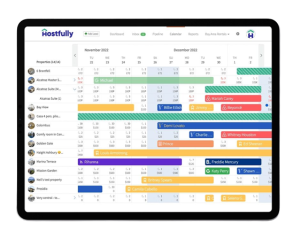
Once you list on multiple OTAs, you need a channel manager to synchronize availability in real time across all platforms. Without one, a booking on Airbnb can leave your Vrbo calendar open for the same dates, creating a double booking. A channel manager pushes your calendar, rates, and availability to all connected platforms simultaneously from one dashboard.
Step 3: Configure platform-specific settings
Each OTA has its own rules for minimum stays, cancellation policies, instant booking requirements, and photo specifications. A channel manager handles availability sync, but you will still need to configure platform-level settings that cannot be centralized, such as Airbnb’s instant booking preference or Booking.com’s cancellation policy options.
Step 4: Optimize each listing for platform search
Listing optimization is platform-specific. Airbnb’s algorithm rewards response rate, acceptance rate, and recent reviews. Vrbo favors listing completeness and booking history. Booking.com weights review score heavily. Do not copy-paste one listing across all platforms. Adjust your title, description, and settings to match each platform’s ranking signals.
Step 5: Monitor and adjust channel performance
Track occupancy and revenue contribution by channel monthly. If one OTA is generating a disproportionate share of bookings at a lower ADR than others, investigate whether your rate strategy or listing presentation is suboptimal on the stronger platforms. Channel mix should evolve with your market and property performance.
See how a 63-property operation runs on one calendar.
Osa Property Management scaled from 15 to 63 properties by syncing Airbnb, Vrbo, Booking.com, and direct bookings into one automated calendar. Zero double bookings since day one. Read the case study.
What do you miss by listing on only one OTA?
Single-platform dependence is one of the most common and costly strategic errors in vacation rental management. The risks are both operational and financial.
Demand gaps that other platforms fill
Each OTA attracts a different traveler segment. Airbnb fills weekends and short leisure stays quickly. Vrbo and Booking.com draw longer-stay guests, family groups, and international travelers who may not even have an Airbnb account. Operators who rely on Airbnb alone frequently report lower midweek occupancy and soft shoulder seasons because they are invisible to the demand sources that fill those gaps.
Hostfully’s 2025 industry data shows that operators with more diversified channel distribution tend to report stronger ADR performance and higher revenue expectations. Vrbo, in particular, appears to function as a stabilizer, reducing the impact of short booking windows and pricing volatility on overall occupancy.
Algorithm and policy exposure
Every OTA changes its algorithm. Airbnb has updated its search ranking criteria multiple times, introducing new factors like listing quality scores and pricing competitiveness thresholds. Operators who generate more than 70% of their bookings from a single platform have no buffer when those changes arrive. A drop in search visibility on one channel can cut monthly revenue by a third overnight if there is no secondary channel already active and generating bookings.
Review concentration risk
Reviews on one platform do not transfer to another. An operator who has built 300 five-star reviews on Airbnb starts from zero on Vrbo or Booking.com if they add those channels later. Starting multi-channel distribution early means building review equity across platforms simultaneously, which compounds over time.
Direct booking ceiling
Direct booking programs benefit from OTA distribution. Guests often discover a property on Airbnb and rebook directly on a subsequent stay. Without visibility across multiple OTAs, the top of that funnel narrows. Operators in Hostfully’s 2025 survey who generated more direct bookings tended to maintain broader OTA distribution, not less.
Nick Halverson, Founder, Osa Property Management (Costa Rica, 63 properties)
“Once we moved to Hostfully, double bookings stopped entirely. With one reliable calendar, we were finally able to scale the business with confidence.” Nick’s team had been managing Airbnb, Vrbo, Booking.com, and direct bookings across spreadsheets when a Christmas Eve double-booking forced a family to find alternative accommodation. After switching, Osa Property Management grew from 15 to 63 properties with zero double bookings. Read the full story.
Who should not list on multiple OTAs?
Multi-channel distribution is the right strategy for most professional operators, but it is not the right move for everyone. There are specific situations where listing on a single channel or a very narrow set of channels is the better approach.
Single-property owners with very high occupancy
If your property consistently runs at 85% or higher occupancy across one channel, adding more OTAs introduces operational complexity without meaningful revenue upside. The marginal bookings you gain are unlikely to offset the coordination overhead, especially if you manage the property yourself without a PMS in place.
Operators without a channel manager
Manually managing availability across more than two OTAs without a channel manager is not a distribution strategy. It is a double-booking waiting to happen. If you do not have a system that syncs calendars in real time, do not expand your channel mix until you do. The cost of a double booking (guest refunds, platform penalties, review damage) far exceeds the cost of the software that prevents it.
Highly regulated markets with strict permit caps
In markets where short-term rental permits cap operating days or require platform registration, adding more OTAs increases visibility to regulators. Some operators in heavily restricted markets deliberately limit their OTA presence to reduce enforcement exposure. This is a minority situation, but it is real in markets like New York City or certain European cities.
Operators targeting a specific niche audience
A luxury property that lists on a curated niche OTA (like Plum Guide or a regional luxury platform) may find that the right single channel outperforms a broad distribution approach. When your target guest is not browsing Airbnb and Vrbo, distributing there creates noise without bookings. Know your guest before you build your channel mix.
Real-world example: Multi-OTA distribution in action
Amber DelPiano, founder of TheStella, manages a portfolio of 48 high-end properties across coastal Italy through a hybrid model that combines niche OTA distribution with direct bookings.
The challenge was structural: many of her properties were listed exclusively on non-English, hyper-local OTAs that international travelers never discovered. There was no clean way to import those listings into a central system and push them to Airbnb, Vrbo, Booking.com, and a branded direct booking site simultaneously.
Using Hostfully’s open API, Amber built a custom integration that imports listing data from local OTAs directly into her property management platform. From there, every property is automatically distributed across five or more booking channels and her own direct booking site.
“Hostfully really is the nucleus of the business,” said Amber. “It gives us the freedom to build the model we envisioned, instead of adapting our vision to the software.”
The result: 2 listing sources and 5+ booking channels managed from one unified system with automatic calendar synchronization. Read Amber’s full story.
Frequently asked questions about OTAs in vacation rental
What does OTA stand for in travel?
OTA stands for online travel agency. In the vacation rental context, it refers to platforms like Airbnb, Vrbo, and Booking.com that allow travelers to search, compare, and book accommodations online. OTAs generate bookings for property managers in exchange for a commission fee on each reservation.
What is the average OTA commission for vacation rentals?
OTA commissions for vacation rentals typically range from 3% to 20% of the booking value, depending on the platform. Airbnb uses a split model, charging hosts approximately 3% and guests a separate service fee. Vrbo charges hosts around 5% plus a payment processing fee. Booking.com typically charges 15% on a host-only commission model. Niche OTAs vary widely.
Who is the largest OTA in the world?
Booking Holdings (which operates Booking.com, Priceline, Kayak, and Agoda) is the largest OTA group globally by revenue. Airbnb is the dominant OTA specifically for short-term and vacation rental inventory. Expedia Group, which includes Vrbo, Hotels.com, and Orbitz, is the second-largest OTA group by revenue.
Do OTA fees reduce my profitability?
OTA commissions are a cost of distribution, similar to a marketing expense. Most property managers factor OTA fees into their pricing strategy. When evaluating OTA profitability, compare the net revenue per booking against the cost of acquiring the same booking through direct channels, including the marketing, website, and payment processing costs that direct bookings require.
What is the difference between Airbnb and Vrbo for property managers?
Airbnb allows shared spaces and individual room listings alongside whole-property rentals. Vrbo lists whole-home properties only and attracts a family-focused, longer-stay traveler demographic. Airbnb has a larger global guest audience. Vrbo tends to generate longer booking windows and fewer last-minute cancellations. Most professional operators list on both to capture different traveler segments.
How do you prevent double bookings when listing on multiple OTAs?
The only reliable way to prevent double bookings across multiple OTAs is to use a channel manager that synchronizes calendar availability in real time across all connected platforms. When a booking is confirmed on one channel, the channel manager immediately blocks the same dates on all others. Manual calendar management across more than two OTAs is not a sufficient safeguard.
Is it better to focus on OTAs or direct bookings?
Most successful vacation rental businesses use both. OTAs provide demand generation at scale that most operators cannot replicate independently. Direct bookings preserve margin and build an owned guest relationship. The typical approach is to use OTAs as the primary acquisition channel and convert repeat guests to direct bookings over time. According to Hostfully’s 2025 industry survey, direct bookings have plateaued at around 20% of the average operator’s booking mix despite increased investment in direct booking programs.
Key takeaways
- An OTA is a third-party distribution channel that generates bookings in exchange for a commission, typically 3% to 20%. It is also your largest source of new guest demand.
- Vacation rental OTAs and hotel OTAs operate by different rules: fee structures, algorithm mechanics, listing format, and guest expectations all differ. Applying hotel OTA logic to your STR distribution is a common and costly mistake.
- Listing on multiple OTAs fills demand gaps that a single platform cannot. Airbnb, Vrbo, and Booking.com each reach different traveler segments; missing any one of them means leaving bookings on the table.
- Multi-channel distribution requires a real-time channel manager. Without one, a double booking is not a risk. It is a certainty as you scale.
- Multi-OTA listing is not the right move for everyone. Single-property owners at full occupancy, operators without sync tools, and those targeting a specific niche may be better served by a narrower channel strategy.
Stop managing channels. Start managing your business.
Connect Airbnb, Vrbo, Booking.com, and more from one place. Every availability update syncs automatically, so you never have to touch each platform individually again. See how Hostfully’s channel manager works.