

Quick Summary
Airbnb phased out traditional host-set security deposits after introducing AirCover for Hosts in 2021, so most hosts can no longer place a deposit hold at checkout. In its place, AirCover provides free damage protection up to $3 million, claimed through the Resolution Center within 14 days of checkout. Airbnb makes an exception for select software-connected hosts, who can collect a deposit off-platform when it’s disclosed under Airbnb’s fee disclosure requirements; Hostfully is one such connected platform. Deposits, damage waivers, AirCover, and insurance each cover a different kind of loss, and most professional hosts run more than one of them together rather than relying on any single layer.
Most Airbnb hosts can’t require a traditional security deposit through Airbnb. The platform phased out host-set deposits after introducing AirCover for Hosts, and guest damage is now handled through AirCover claims rather than money held upfront. The one exception: Airbnb permits select software-connected hosts to collect a security deposit off-platform, provided it’s disclosed under Airbnb’s fee disclosure requirements.
That paragraph is the policy. The rest of this guide covers what it means in practice: how AirCover claims actually work, how the software-connected exception operates through a platform like Hostfully, what to charge if you qualify, and how deposits compare with waivers and insurance.
What happened to the Airbnb security deposit?
Before 2021, Airbnb let you manage security deposits through your account. You could set an amount and claim it back if guests damaged your property during their stay, as with other listing sites.
Airbnb arranged this through a temporary hold on users’ cards. If hosts reported an issue to the Resolution Center, the platform would charge the guest. If not, the hold would simply expire.
In winter 2021, Airbnb announced its new AirCover for Hosts. This offered free damage protection for up to $1 million for all hosts with any booking made through the platform. Over the next year, the platform then phased out the security deposits, so it was no longer possible to place temporary holds.
What is Airbnb’s security deposit policy for hosts today?
Airbnb’s policy today has two tracks: AirCover for Hosts as the default damage protection on every booking, and a narrow exception that lets select software-connected hosts collect a deposit outside the platform. Most hosts operate entirely on the first track, so that’s where to start.
AirCover for Hosts is Airbnb’s alternative to security deposits. Instead of hosts collecting the money upfront, you must request payment through the Resolution Center after the guest’s stay. You’re eligible for up to $3 million in damages, along with liability coverage from the moment you accept your first booking.
While it may seem similar, AirCover is different from traditional insurance. It doesn’t provide coverage for natural disasters or direct bookings like specialist policies do.
Damage protection is one of the platform systems every operator inherits by default, alongside the fee structure and status programs that shape the rest of hosting on Airbnb.
Misty Valdez, owner of 282 Timbuktu Cabin, says AirCover has been reliable in her experience. “That said, I do wish Airbnb offered a traditional security deposit,” she adds, “I think having a regular deposit would be helpful. If guests had a little more skin in the game, there might be less damage and fewer small issues overall.”
How to manage the Airbnb claims process
If guests cause damage during a stay, act quickly and follow the right steps. While Airbnb has a structured process, hosts must meet all the requirements to successfully make a claim.
Here’s what you need to do:
- Document the damage immediately: As soon as you discover an issue, take clear photos or videos. If repairs are needed, gather written estimates or invoices. The more detailed your evidence, the stronger your claim.
- Submit a request through the Resolution Center: You must file your reimbursement request within 14 days of the guest’s checkout. Miss this window, and your claim automatically becomes ineligible.
- Allow 24 hours for the guest to respond: Airbnb gets in contact with the user and they have a day to accept, partially pay, or decline. Many issues are resolved at this stage without escalation.
- Escalate to AirCover if needed: If the guest does not respond or declines payment, you can escalate the case. Airbnb’s support team will review your evidence and decide whether the claim qualifies for reimbursement under Airbnb’s damage policy.
Pro host tip: Use turnover management software to help you stay organized throughout the AirCover process. Leading solutions help you monitor property conditions before and after stays, and collect photos from your cleaning teams to back up your claims.
Security deposit vs damage waiver vs insurance: what’s the difference?
Hosts use several different money mechanisms for damage, and they’re routinely confused because all of them “cover damage” in some sense. They differ on who pays, when the money moves, and what size of loss they’re built for, and most professional operators run two or three together rather than relying on any single one.
| Security deposit | Damage waiver | AirCover for Hosts | Host insurance | |
|---|---|---|---|---|
| Who pays | Guest, refundable | Guest, non-refundable small fee | Built into the platform, no charge | Host, as a premium |
| When money moves | Held before the stay, captured only if damage occurs | Collected at booking, every stay | After a claim, filed within 14 days of checkout | After a covered claim, per policy terms |
| Built for | Small-to-mid incidents, fast recovery, guest accountability | Routine minor damage without claims friction | Guest-caused damage up to the program limits | Large losses, liability, perils platform programs exclude |
| Key limitation | Not in Airbnb’s standard flow; exception for select software-connected hosts, with disclosure | Capped coverage; the fee adds to guest cost | Not insurance: excludes things like natural disasters and doesn’t cover direct bookings | Premiums and deductibles; needs STR-specific coverage |
The one-sentence version of the distinction that matters most: a deposit is the guest’s money held against damage, while insurance is your policy against large losses, and AirCover is a platform protection program that is neither. Deposits and waivers handle the broken lamp; insurance handles the burst pipe and the injury claim.
Where the layers meet your other choices: the stack you run should match how you screen, since screening reduces how often the money layers get tested at all. The vetting side is covered in our guide to Airbnb guest screening, and the insurance layer in depth in our short-term rental insurance guide.
How can software-connected hosts still collect a deposit?
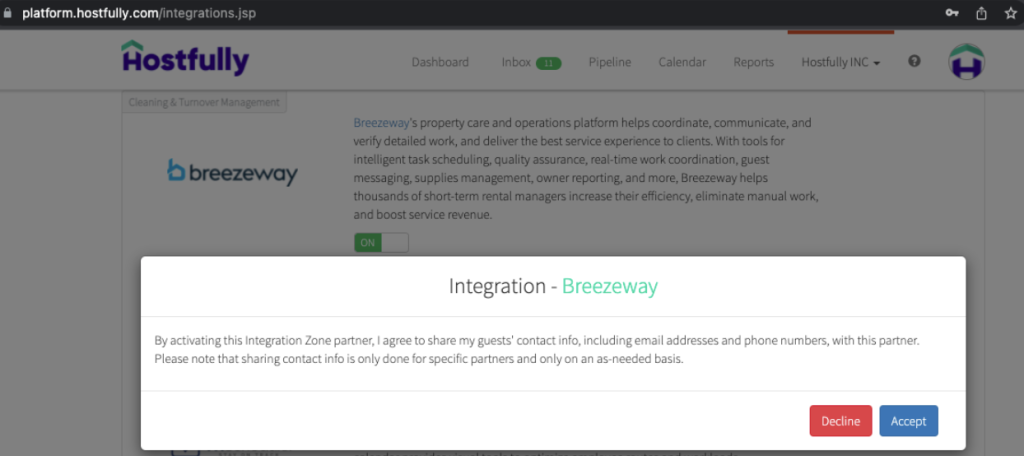
Airbnb describes this as an exception for select software-connected hosts: hosts managing their listings through connected software, such as Hostfully, may collect a security deposit outside Airbnb’s checkout process. The condition is disclosure through Airbnb’s fee disclosure requirements, so guests see the deposit before they book.
Airbnb doesn’t handle this type of security deposit. Instead, you process it through your PMS and the payment providers you use. After booking, guests typically receive a secure link where they can authorize a card hold or provide payment details for the deposit.
This setup gives you an additional layer of protection alongside AirCover. When you communicate it clearly and handle it through approved software, it can fit smoothly into your booking workflow without affecting Airbnb’s built-in protection.
If you collect an off-platform deposit, the terms belong in writing: the amount, the hold-and-release window, and the damage process, all of which live naturally in an Airbnb rental agreement guests sign before check-in.
How to set up an Airbnb security deposit as a software-connected host
Setting up a security deposit through your PMS can add an extra layer of protection, but you must handle it properly to comply with Airbnb policies.
- Step 1: Make sure you have an approved system: Make sure you’re using an approved partner like Hostfully that connects directly to Airbnb and supports compliant workflows.
- Step 2: Sync with Airbnb: Check your listings are fully connected through your PMS. Leading solutions like Hostfully can help you set up and manage integrations.
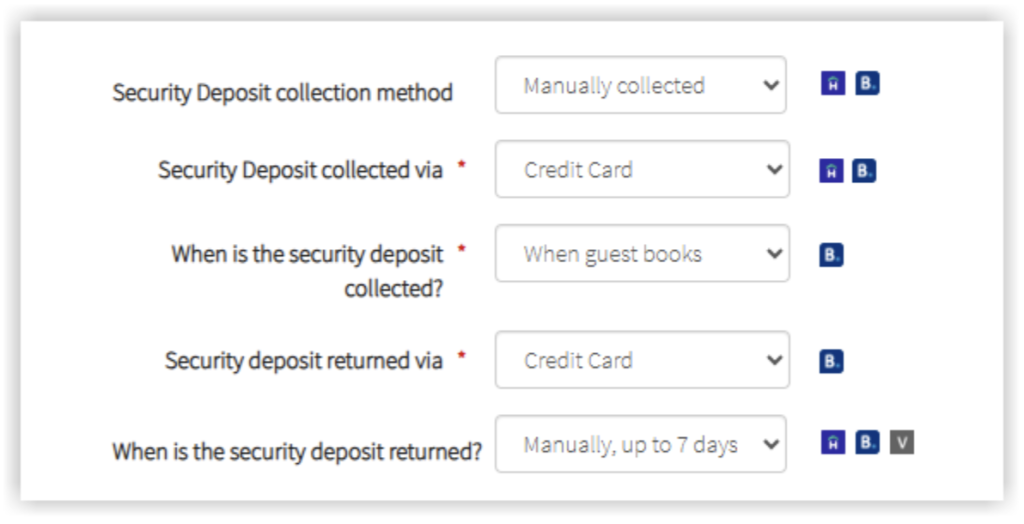
- Step 3: Decide how to handle the deposit: Choose the amount, whether you will pre-authorize or collect funds, and how long you will hold them.
- Step 4: Disclose the deposit per Airbnb’s fee disclosure requirements: Guests must see that you collect a security deposit outside of Airbnb before they book. This step is what keeps the exception compliant, and it builds guest trust.
- Step 5: Trigger collection after booking: Once a guest confirms a booking, Hostfully can automatically request and process the security deposit using your connected payment processor.
- Step 6: Hold or release funds: After check-out and inspection, tell your PMS whether you want to keep all or part of the deposit amount.
How much should you charge for an Airbnb security deposit?
There’s no single right amount for an Airbnb security deposit. The ideal figure depends on a variety of factors, including:
- Property type and size
- Nightly rate
- Typical guests
- Risk level
- Amenities
It’s also important to consider how much competitors are asking for security deposits. If you charge much higher, you may put some people off.
As a working benchmark (a Hostfully recommendation rather than an industry statistic), hosts who collect deposits typically land around one night’s rate or 20-30% of the total booking value. Try to stay at or below that band. The goal is to cover minor damages, not major repairs or replacements for your property, as that is what insurance is for.
If you have high-value items, consider whether you really want to risk them rather than increasing your deposit amount. It may make more sense to remove them. Often, guests appreciate amenities like high-speed internet and coffee machines over luxury decor anyway.
Pros and cons of charging Airbnb guests security deposits
Security deposits can give you extra reassurance, but it’s important to be aware of the advantages and disadvantages. You can be more prepared for potential issues.
| Pros | Cons |
|---|---|
| Adds an additional layer of financial protection beyond AirCover | May create friction during the booking process |
| Encourages guests to treat the property with care | Higher deposits can deter some travelers |
| Gives you more control over reimbursement timelines | Requires clear communication and strict compliance with Airbnb rules |
| Can reduce out-of-pocket costs if minor damage occurs | Gives you extra admin work to do |
| Helps standardize policies across channels | Leads to negative reviews if you need to claim the deposit |
Tips for handling security deposits on Airbnb
The way you manage security deposits can make a big difference to how well your business runs. You have to be aware that your potential guests have lots of options, and a poorly thought-out policy can drive them away.
Follow these best practices to keep the process professional and compliant:
- Make sure guests understand: “It can be a little confusing since every platform handles things differently,” says Valdez, “I just make sure my house rules are very clear and that guests understand expectations upfront.”
- Research local regulations: Local authorities may have their own rules for tourist accommodation that you need to follow.
- Understand your rights: Make sure you know what you can file claims for through AirCover to avoid unnecessary work and frustrating guests. For example, anything that’s clearly the result of wear and tear rather than carelessness isn’t likely to be covered.
- Automate where possible: Use a PMS like Hostfully to set custom workflows for security deposits to reduce your workload and maintain accuracy.
Deposits deter best when they sit beside clear expectations, which is the job of well-written Airbnb house rules guests agree to at booking. And deposits are only the financial layer of protecting a property; the physical and digital layers around them are covered in our vacation rental security tips.
- Keep a record of everything: Valdez says, “Take detailed photos before and after each stay, and have your cleaning team do the same. If something does happen, report it quickly and provide clear proof. Keeping good records makes the process much easier if you ever need to file a claim.”
- Inspect quickly after checkout: Conduct property checks as soon as possible so you can discover issues and easily make claims within the timelines.
Stay on top of damages with Hostfully
Airbnb security deposits may work differently today, but still offer a variety of ways to protect your property from damages. Whether you rely on AirCover alone or add an API-connected deposit through approved software, the key is setting up a process that works consistently across all your channels.
That is where Hostfully makes a difference. As an approved Airbnb partner, Hostfully helps you manage deposits compliantly, streamline claims documentation, and keep policies aligned wherever you list.
With Hostfully PMS, you can:
- Sync Airbnb listings seamlessly
- Collect and automate security deposits outside Airbnb where permitted
- Centralize guest communication in a unified inbox
- Trigger automated messages and payment requests
- Track tasks and inspections after checkout
- Keep an eye on properties with smart devices
- Monitor performance and stay organized across multiple channels
Managing deposits, claims, and guest communication in one powerful system helps you stay organized and respond quickly when issues arise.

FAQs about Airbnb security deposits
Can regular Airbnb hosts charge security deposits?
Generally, Airbnb hosts can’t charge security deposits. The platform hasn’t allowed users to set them since 2022, when it introduced the AirCover program for damage protection. However, Airbnb makes an exception for select software-connected hosts, who can collect a deposit off-platform when it’s disclosed under Airbnb’s fee disclosure requirements.
What is the average security deposit for Airbnb?
There’s no official average, because Airbnb no longer sets or holds deposits itself. As a Hostfully benchmark rather than an official figure, software-connected hosts who collect one off-platform usually set it around one night’s rate or 20-30% of the total booking value. Keeping the amount at the lower end for your market protects you against minor damage without deterring bookings.
What’s the deadline to file a damage claim?
You must file a damage claim within 14 days of the guest’s checkout, or it immediately becomes ineligible. If they deny your claim, you can escalate it to Airbnb’s Resolution Center for review.
Can I charge deposits on Vrbo and Airbnb with different amounts?
Yes, Airbnb and Vrbo have separate policies, so you can charge different amounts. That said, keeping your security deposits consistent across platforms and channels often makes operations simpler and avoids confusion with guests.
Is it normal to pay a security deposit on Airbnb?
For most listings, no. Airbnb doesn’t hold traditional security deposits, and guest damage is handled through AirCover instead. A minority of software-connected hosts do collect a disclosed deposit off-platform, which is legitimate when it appears in the listing before booking. A deposit request that only appears after booking, or that asks for payment outside secure channels, is a red flag.
Key takeaways
The deposit question on Airbnb is really a protection-stack question, and the stack has more layers than it did five years ago.
- Most hosts can’t require a traditional security deposit through Airbnb; AirCover for Hosts is the default damage protection on every booking.
- Select software-connected hosts are the exception: they can collect a deposit off-platform when it’s disclosed under Airbnb’s fee disclosure requirements.
- AirCover claims run through the Resolution Center and must be filed within 14 days of checkout, with documentation doing most of the work.
- Deposits, damage waivers, AirCover, and insurance cover different loss sizes; professional operators layer them rather than picking one.
- If you collect a deposit, size it modestly (around one night’s rate as a Hostfully benchmark) and put the terms in a signed rental agreement.